Refill is vertical
New fruit enters at the top of a column and falls straight down. Nothing moves sideways unless you swap it. A column you empty is a column you have rerolled; a column you never touch keeps the same pieces all stage.
Every stage in this game opens with a small panel at the top telling you what it wants. Almost nobody reads it properly, and almost every failed stage traces back to that. This fruit match pop puzzle strategy starts with the panel, because once you can read it the rest of the board follows.
Four goal types cover nearly every stage in the campaign. They look similar in the panel and behave nothing alike on the board.
| Goal type | Counter shows | Moves usually given | What ends the stage |
|---|---|---|---|
| Collect fruit | A fruit icon and a number remaining | Generous | The count reaching zero, or moves running out |
| Clear the ground | A tile pattern and a number of cells | Tight | Every marked cell being uncovered |
| Bring items down | An object with an arrow | Very tight | Each object reaching the bottom row |
| Reach a score | A number and a progress bar | Moderate | The bar filling before the counter empties |
A description of how the four goal formats behave in play. Exact counts, move allowances and board shapes differ between versions; the in-game briefing before each stage is the current source.
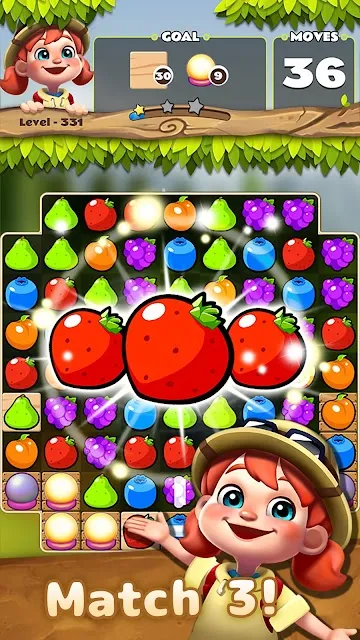
Collect stages are the friendliest, and the trap in them is playing whatever is convenient. If the panel wants eighteen red fruit, then a beautiful five-piece match of yellow is worth nothing at all beyond the points. Look at the colour in the panel, find it on the board, and play only that until the count is close.
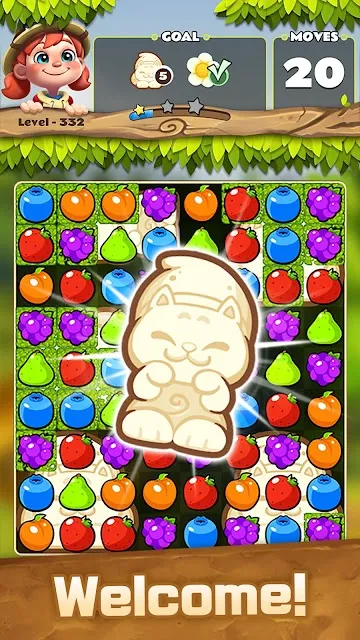
Ground-clear stages invert the priority. Here the tiles are irrelevant and the cells beneath them are the whole game, which means position matters more than size: three pieces cleared over an uncovered cell beat six cleared over ground you have already exposed. These stages are also where board outline bites hardest, because a marked cell in a narrow corner may never be reached by ordinary cascades.
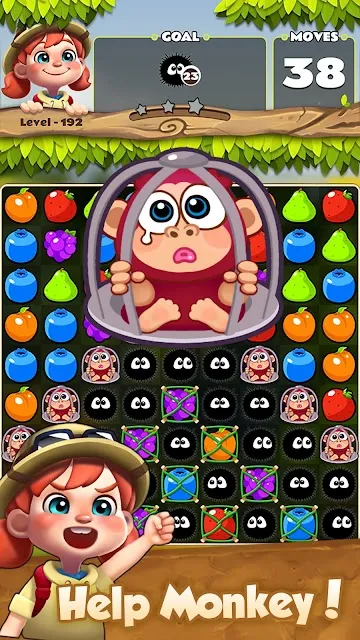
Item-delivery stages are the tightest in the game and the most mechanical. The object descends one row each time the tile directly beneath it disappears, and nothing else moves it. Matching beside it is wasted. Look straight down, count what is in the way, and clear that column.
Score stages are the only ones where speed of thought is worth anything, and even then only because some of them run a timer. Take the largest cluster available rather than the neatest; a big clear scores disproportionately more than two small ones because of the cascade it sets off.
One rule sits underneath every piece of advice on this page, and it is worth stating on its own.
New fruit enters at the top of a column and falls straight down. Nothing moves sideways unless you swap it. A column you empty is a column you have rerolled; a column you never touch keeps the same pieces all stage.
Clear three pieces on the bottom row and everything in those columns shifts down, lands beside new neighbours and often matches again without costing a move. The same clear on the top row refills from empty space, where nothing can connect.
Ground-clear stages sometimes mark cells only in the upper half. Then the rule reverses, because a cascade you cannot see the benefit of is a cascade you did not need. Read the panel first; the rule serves the goal, not the other way round.
Before each move, look at the bottom third of the board first. If there is a workable match down there that serves the goal, it is almost always the right one. Only when there is not does the top half deserve attention.
In this format, yes. The stage progression is designed to be completable with ordinary play, and purchases buy convenience — extra moves, boosters, skipping a wait — rather than access. A stage that appears to require a purchase is usually a stage that requires a different opening move. Whether a specific app follows that pattern is stated by its in-app purchase label on the store listing.
The board is computed on the device, so standard puzzle stages generally continue offline once the app has been opened at least once. Leaderboards, cloud saves, daily rewards and timed events all need a connection. The honest test takes thirty seconds: switch on flight mode, open the app, start a stage.
Usually the colour count went up. A board that used five fruit types and now uses six produces noticeably fewer useful matches from the same arrangement, and nothing on screen announces it. Count the distinct fruit before you start.
Only if the arithmetic works. Take what the goal still needs, divide by the moves being offered, and ask whether ordinary play averages that. If it needs four collected fruit per move and you have been averaging one and a half, the extra moves will not close it.
The game defines none of these, and most guides use them loosely.
The refill that follows a clear. Pieces drop into the gap, meet new neighbours and can match again with no move spent.
The strip above the board showing what the stage counts. It is the only thing that decides whether a move was good.
A column that moves rarely because of the board outline. Anything the stage needs from inside one has to be routed there deliberately.
Anything created by a match of four or more. Its value is measured in goal progress, not in tiles removed.
Goal remaining divided by moves remaining. Above three per move, ordinary play will not close the gap.
The shape of the playable area. Irregular outlines create starved columns and are the main source of difficulty in late stages.
Everything on this site is free and stays free. What a page cannot do is sit beside the phone while a stage is open, and the goal panel is exactly the thing worth having there.
Sixteen pages built as an exercise book rather than a guide. Each spread takes one goal type, shows a board, and asks what the opening move should be before turning over.
Order it by email Terms of the order
A single item sold by a private individual, not a shop. There is no checkout on this domain, no payment page and no card details are collected anywhere: you write, Matthew Campbell replies with transfer details, and the file follows once the transfer arrives. No sales tax is added and no invoice from a registered business is issued. If it never arrives, or arrives and will not open, say so and the payment is returned in full.
Facts about a particular app belong on its store page rather than here, so here is one with its labels exactly as the store shows them. Nothing is downloaded from this site.

Open the listing on Google Play
Price, taxes and any fees are shown on Google Play at the next step. Developers change listings without notice, so the date above records when these labels were last read from here.
Email is the only channel here. No forms and no data collection anywhere on this site — you write, and the reply comes back to the address you used.